The Homeowner's Wildfire Claim Playbook
What insurance doesn't explain about wildfire claims — and what the community-scale loss changes. A 7-part guide covering the pre-access period, FAIR Plan coverage, state regulatory protections, smoke-only claims for surviving structures, and the multi-year rebuild arc. Includes California-specific protections and western state callouts throughout.
The Homeowner's Wildfire Claim Playbook
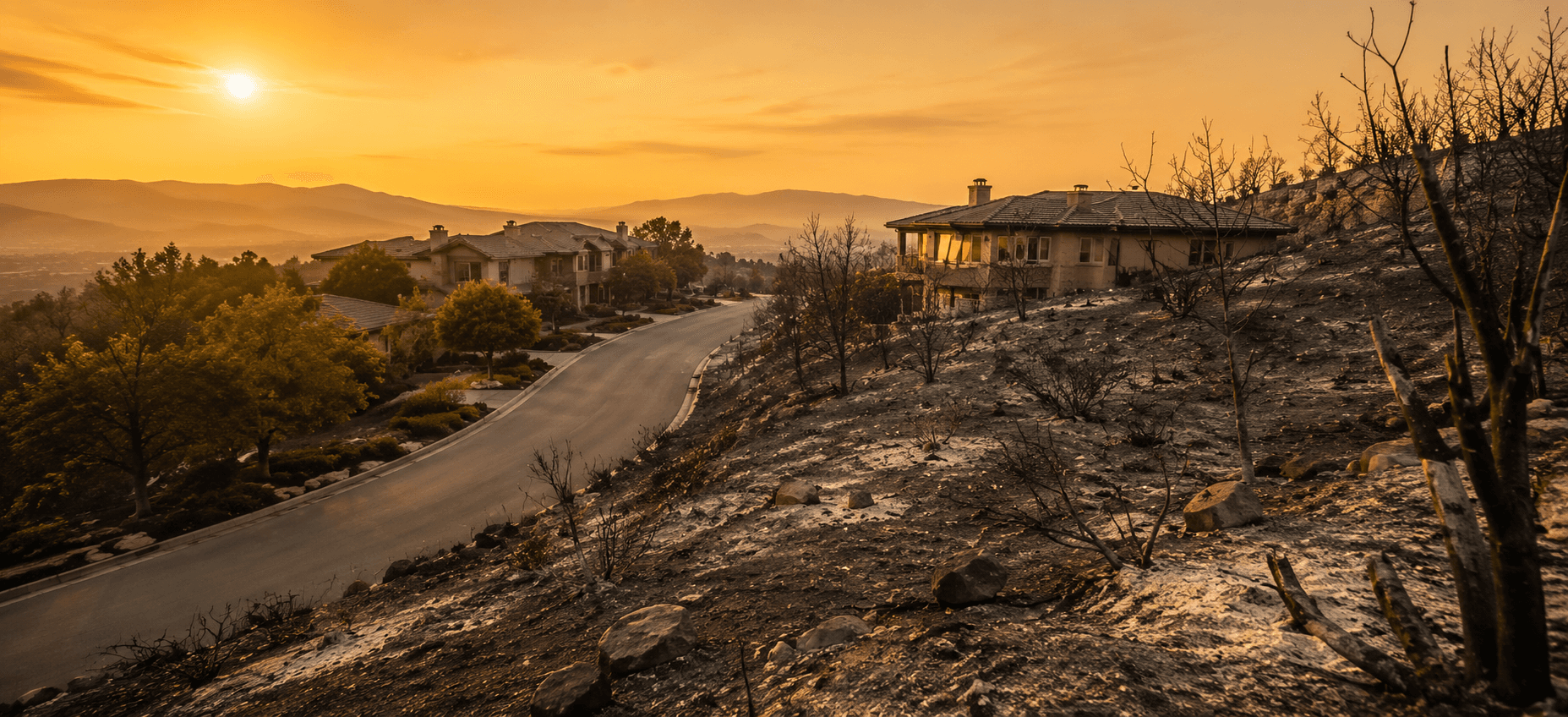
You may be filing a claim on a home you haven't seen since you left. That's the defining feature of wildfire claims — mandatory evacuations can last days or weeks, the claim is already running before you know the extent of the loss, and the community-scale nature of the event means every contractor, every adjuster, and every permitting office in the area is overwhelmed simultaneously.
Wildfire claims are the longest and most complex in residential insurance. Total loss rebuilds routinely take 2-4 years. The homeowners who reach fair outcomes aren't the ones who pushed hardest. They're the ones who stayed organized longest — and who understood their coverage, their state's protections, and the specific traps of this claim type before they encountered them.
ALE Starts at Evacuation — Not at Confirmed Loss
This is the most important practical insight in wildfire claims, and most homeowners don't know it.
Many policies provide ALE from the point of a mandatory evacuation order, without waiting for a confirmed loss — but this is policy language, and it varies. Ask your carrier explicitly: "Does my ALE coverage apply from the date of the evacuation order?" and get the answer in writing. Save every receipt from the moment you leave either way.
Save every receipt from the moment you leave: hotel, meals, pet boarding, mileage, storage for anything you took with you. Call your carrier as soon as possible — even before you know the extent of your loss. Report that your property is in an evacuation zone, get a claim number, and ask for an ALE advance. Ask whether an ALE advance is available — the answer is always no if you don't ask. You should not be floating weeks of hotel costs on a credit card.
What Your Insurer Is Watching For
Coverage limits, not coverage disputes. Unlike most disaster types, wildfire claims rarely fight on coverage — fire and smoke are covered perils in standard HO-3 policies. The disputes are about limits. The most common and most damaging gap is an underinsured Coverage A limit that hasn't kept pace with construction cost inflation. A home insured for $400,000 may cost $600,000 to rebuild today. Pull your Coverage A limit and compare it to current construction costs per square foot in your area before the adjuster arrives.
Ordinance and law exposure. Wildfire rebuilds trigger code upgrades aggressively — California Chapter 7A ignition-resistant construction standards, ember-resistant vents, multi-pane windows, fire sprinkler requirements in many jurisdictions, non-combustible decking. These requirements can add 15-30% to a rebuild budget above the standard scope. Your Ordinance and Law coverage limit determines how much of this the carrier pays. Default O&L limits of 10% of Coverage A are almost always inadequate for wildfire rebuilds.
Contents completeness. On a total loss, the contents inventory represents tens or hundreds of thousands of dollars in settlement value. Incomplete inventories are the most common source of unclaimed recoverable value — the inventory is yours to build, and what you don't document isn't part of the claim.
Before and Immediately After Access
During the evacuation wait — use the time: Pull your declarations page and know your numbers before the adjuster arrives: Coverage A, ALE limit, Ordinance and Law limit, any scheduled personal property endorsements, and whether you have guaranteed replacement cost, extended replacement cost, or standard limits. Check whether your state has issued any post-disaster emergency orders. Start your contents inventory from memory immediately — every day that passes, you'll forget more items.
When access is restored — document before anything is touched: Photos and video from every exterior angle. Interior room by room if the structure is standing and safe. Debris field documentation before any cleanup. If it's a total loss, document from the perimeter first. Don't enter a compromised structure until a structural engineer or fire department confirms it's safe.
What not to sign in the first week: Within hours of access, you will be approached by restoration contractors, public adjusters, and attorneys. Many are legitimate. Some are not. Do not sign an Assignment of Benefits in the first week — or at all without independent legal review. Do not sign a contingency contract with a public adjuster while standing in front of your property for the first time. Do not sign any reconstruction agreement until you have the carrier's scope, at least two contractor bids, and a clear understanding of your coverage limits.
FAIR Plan and the Coverage Crisis Context
In California and a growing number of western states, homeowners in high wildfire-risk areas have been dropped by standard carriers and forced onto state FAIR Plans — the insurer of last resort.
The California FAIR Plan provides real insurance that pays real claims — but it is more limited than a standard HO-3. It covers the structure up to policy limits (the published dwelling limit has been raised in recent years — confirm the current maximum against the California FAIR Plan's own published terms, as these figures change) and personal property with a contents rider. It does not include liability coverage — for that you need a separate Difference in Conditions (DIC) policy. ALE coverage is available but must be specifically included with its own limit.
If you have both a FAIR Plan and a DIC policy, you may have two claims to coordinate. Understand which policy covers which component of your loss before the adjusters arrive.
If you were non-renewed by a standard carrier and moved to the FAIR Plan in recent years, compare your current coverage against your prior policy. Extended replacement cost, guaranteed replacement cost, and scheduled property riders may have dropped off in the transition. Understand that gap before you finalize your claim scope.
FAIR Plan policies contain their own dispute and appraisal provisions — read them in your policy rather than assuming they match a standard HO-3, and confirm what applies with the California Department of Insurance.
California State Protections
California has enacted post-disaster homeowner protections — extended ALE, a contents advance for total losses, non-renewal limits, and extended filing deadlines — that apply after a declared state of emergency. These provisions have been amended repeatedly; verify current law and confirm applicability with the California Department of Insurance.
Non-renewal moratorium: After a declared wildfire disaster, California law has restricted the non-renewal of policies in affected ZIP codes for a set period. The exact scope and duration have changed over time — confirm what currently applies with the California Department of Insurance.
Extended ALE: California has provided for ALE beyond the policy's stated time limit for the period reasonably necessary to rebuild after a declared disaster. The specifics have been amended over time — confirm the current provision and its applicability to your event with the California Department of Insurance. Because wildfire rebuilds routinely take 18-36 months, track your ALE spending against your limit from the first week.
Extended claim filing deadlines: California has extended the time to file certain claims beyond the standard policy deadline after a declared disaster. Confirm the current deadline that applies to your claim with the California Department of Insurance rather than relying on a specific figure.
Contents advance without full itemization: California provides total loss homeowners a contents advance without submitting a full itemized inventory, commonly described as a percentage of the dwelling limit. The percentage and any cap are set by current law and a declared emergency — confirm the current figure and applicability with the California Department of Insurance. A full inventory generally recovers more, so compile it while using any advance for cash flow.
Contact the California Department of Insurance to confirm which protections apply to your specific event and ZIP code. Document that conversation in writing.
Other western states: Colorado, Oregon, and Washington have varying levels of post-disaster protections that have expanded in recent years. Contact your state insurance commissioner's office within the first two weeks after a wildfire event to understand what emergency orders have been issued and what rights they confer.
The Contents Inventory
The contents inventory is among the most labor-intensive and most financially significant parts of a wildfire total loss claim. It consistently represents unclaimed value when not done thoroughly.
Start immediately from memory — before access. Every day that passes, you'll forget more items. Begin room-by-room reconstruction now. Don't filter yourself at this stage — list everything you can remember and let the documentation determine what gets paid.
Work room by room, ceiling to floor. Two or three rooms per day is a sustainable pace. Include closets, cabinets, attic storage, garage. Have every adult in the household do this separately — different people remember different things.
Use every evidence source available:
- Phone photo libraries going back years — holiday gatherings, birthday parties, any image taken inside the home shows what was on the shelves, on the walls, in the background
- Online order histories: Amazon, Wayfair, Best Buy, Apple, Costco — years of records with exact prices
- Credit card and bank statements: search for furniture stores, electronics retailers, appliance stores, jewelry stores
- Real estate listing photos if you purchased the home in recent years
- Social media photos posted from inside the home
- Email receipts and warranty registrations
Research current replacement cost for each item — not what you paid, but what an equivalent item costs today. A dining table purchased for $1,200 eight years ago may cost $2,500 today. This is the baseline for the RCV calculation.
California 30% baseline: California provides a contents advance for total losses without full itemization, subject to current law and a declared emergency — confirm applicability and the current figure with your carrier or the California Department of Insurance, then use it for cash flow while you build the complete inventory.
Smoke-Only Claims: When Your House Survived
Not every wildfire claim is a total loss. Homeowners whose structures survived — sometimes in the middle of a burned neighborhood — still have legitimate claims.
Smoke is a named peril under most standard homeowners policies, and smoke damage does not require direct flame contact or that the smoke originated on your own property. Coverage determinations are made by your insurer based on your specific policy — if smoke damage is disputed, ask for the specific policy language in writing.
Wildfire smoke is different from structure fire smoke — it contains combustion byproducts from vegetation, structures, vehicles, and sometimes industrial materials. It lingers for days or weeks at elevated levels. HVAC systems pull smoke continuously and distribute particulates throughout the entire structure. Exterior surfaces accumulate acidic ash residue. Interior surfaces absorb odor at a molecular level that may not be immediately apparent.
The four cleaning-versus-replacement determinations in a smoke assessment:
- HVAC and ductwork — whether cleaning the system removes deposition from the ducts themselves, or whether duct replacement is indicated
- Soft goods — whether odor remains detectable after professional cleaning
- Electronics — whether a powers-on test is sufficient, given that soot deposition causes progressive corrosion that may not present at the time of inspection
- Exterior surfaces — whether cleaning removes acidic ash residue, or whether surface treatment and repainting are indicated
Remediation is assessed on whether cleaning fully removes the contamination. Where odor or residue persists after professional cleaning, that finding is what the assessment records — ask your remediation contractor to document post-cleaning odor and residue testing.
If the surrounding neighborhood burned but your home survived: Contractor access will be severely limited while total-loss demolition is ongoing in the area. Document the mitigation efforts you made and the dates on which contractors were unavailable, and keep that record with your claim file. If demolition dust and particulates make the property effectively uninhabitable, document this with air quality testing and maintain your ALE claim for that period.
The Rebuild: Real Timelines and Real Challenges
A total-loss rebuild is measured in years, not months. That is rarely what anyone expects at the outset, and the distance between the expected timeline and the real one is where much of the strain lives — decisions made early, under pressure, on the assumption of a much shorter horizon. Knowing the actual shape of it won't shorten the rebuild, but it makes the long middle legible instead of alarming, and it lets you plan around the stages rather than be caught out by each one in turn.
Realistic wildfire rebuild timeline for a total loss:
- Months 1-3: Access restoration, hazardous debris clearance by authorities, documentation and adjuster inspection
- Months 1-3 (overlapping): Scope negotiation with carrier, contractor selection
- Months 3-9+: Permitting — after major California wildfire events, permitting timelines of 9-18 months have been documented as every home in the affected area permits simultaneously
- Months 12-24+: Construction
- Months 1-2: Inspections, punch list, certificate of occupancy
Total from loss to move-in: commonly 2-4 years for a total loss in a major wildfire event. Plan your ALE coverage, housing, and finances accordingly.
Debris removal: After declared disasters, state or county authorities often conduct the initial hazardous debris removal at no cost to the homeowner. There is usually an opt-out process — if you opt out, you handle your own removal and must meet the same standards. Your insurance policy has a debris removal sublimit within Coverage A (commonly 5%). Understand that number before authorizing independent debris work.
Contractor selection: Verified license and bonding, general liability and workers' comp certificates, references specifically from post-disaster rebuild work, written line-item estimates that match or exceed the carrier's scope, realistic milestone timeline in writing, no AOB language in the contract, draw schedule tied to documented milestone completion with lien waivers at each draw.
When the carrier's estimate and the rebuild cost diverge: These two numbers commonly differ on a wildfire rebuild — construction inflation, labor scarcity, and code upgrade requirements all move actual cost after an estimate is written. Different categories of cost are addressed by different parts of the policy: costs discovered during construction are addressed through supplemental claims supported by contractor documentation; code-required upgrades are addressed by Ordinance and Law coverage; broad cost escalation is addressed by an extended replacement cost rider where the policy includes one. Where the divergence is large and remains unresolved, a public adjuster with wildfire rebuild experience is the licensed route.
State-Specific Notes
California has the most robust state protections for wildfire homeowners (see above). Chapter 7A construction standards apply to wildfire rebuilds and create significant code upgrade costs. The California Department of Insurance at insurance.ca.gov is the primary resource for claims assistance and emergency order information.
Colorado passed HB22-1301 requiring carriers to offer extended replacement cost in high-risk areas and provides additional post-disaster claim protections. Colorado Division of Insurance at doi.colorado.gov. Verified as of 2026-07-20; confirm current law.
Oregon and Washington have enacted post-disaster protections in recent years — contact the Oregon Division of Financial Regulation or the Washington Office of the Insurance Commissioner for what applies to your event.
All western states: Wildfire events routinely generate state emergency declarations that trigger insurer obligations. Contact your state insurance commissioner's office within the first two weeks of any wildfire event to understand what emergency orders apply and what rights they confer.
Frequently Asked Questions
ALE started when I evacuated — how long does it last? Standard policy ALE coverage lasts until your home is habitable or your ALE limits are exhausted — whichever comes first. California has enacted post-disaster protections that can extend ALE beyond the policy's stated limits after a declared emergency; these provisions have been amended repeatedly, so confirm current law and applicability with the California Department of Insurance. In other states, when the policy limit is hit, ALE ends — which is why tracking cumulative spending monthly against your limit matters from the first week.
My Coverage A limit seems too low to actually rebuild. What are my options? First, get an independent general contractor estimate for a full rebuild to current code. If it significantly exceeds Coverage A, you have several options depending on your policy: extended replacement cost or guaranteed replacement cost riders provide additional headroom above Coverage A; Ordinance and Law coverage addresses code-required upgrades; and supplemental claims can address costs discovered during construction. If the gap is large, a public adjuster with wildfire rebuild experience can be valuable specifically at this stage.
I'm on the California FAIR Plan. How is my claim different? The FAIR Plan adjuster assigned to your claim follows the FAIR Plan's process rather than a standard carrier's. Initial offers after major fire events have sometimes been lower than warranted — you have the same rights as any policyholder to dispute scope, request re-inspection, supplement, and invoke the appraisal clause. If you also have a DIC policy, coordinate carefully between both insurers on which component of the loss each covers.
How do I handle my contents claim if I have no records? Start from memory — room by room, ceiling to floor — before you have access to the property. Every day that passes, you'll forget more. Then use every available evidence source: phone photo libraries, social media posts, email receipts, online order histories, bank and credit card records. California total loss homeowners can receive 30% of the dwelling limit without full itemization — use that for cash flow while you build the complete inventory. In other states, the inventory is your only path to full contents recovery.
How soon should I hire a public adjuster? Don't make that decision while standing at your property for the first time. Assess your situation first — extent of loss, coverage adequacy, complexity of the claim. Public adjusters are most valuable in wildfire claims when: Coverage A is significantly below rebuild cost and you need aggressive supplement negotiation; you're on the FAIR Plan and initial offers are low; or the claim has stalled after 3-4 months without resolution. Verify their license through your state's insurance department and understand their fee structure (typically 10-15% of the settlement) before signing.
What should I do before signing a final settlement release? Confirm that all of the following are resolved: every supplemental claim filed and paid, recoverable depreciation received for all replaced items (this deadline is commonly 180 days to one year from loss — don't miss it), all ALE reimbursements for the full displacement period, contents claim settled, ordinance and law costs paid to your coverage limit. A final release closes the claim permanently. Don't sign until everything owed is in hand.
A wildfire claim on a total loss is a 2-4 year project at the highest financial stakes most homeowners will ever face. Starting organized and staying organized — knowing your numbers before the adjuster arrives, tracking ALE monthly, filing supplements as costs emerge, understanding the state protections available to you — is what determines whether the claim reflects your full documented loss rather than falling short from exhaustion.
ClaimEase tracks every communication, every document, and every expense across the full arc of a wildfire claim — so the documentation discipline doesn't break down under the pressure of a process that lasts years.
ClaimEase provides general guidance. Coverage determinations are made by your insurer based on your specific policy terms. California state protections apply when a state of emergency has been declared covering your area — confirm applicability with your carrier and the California Department of Insurance. Consult a licensed public adjuster or insurance attorney for specific advice about your claim.