Why Letting a Contractor Deal Directly With Your Insurer Is Risky
Letting your contractor handle your insurance claim directly can cost you control of your claim — and your money.
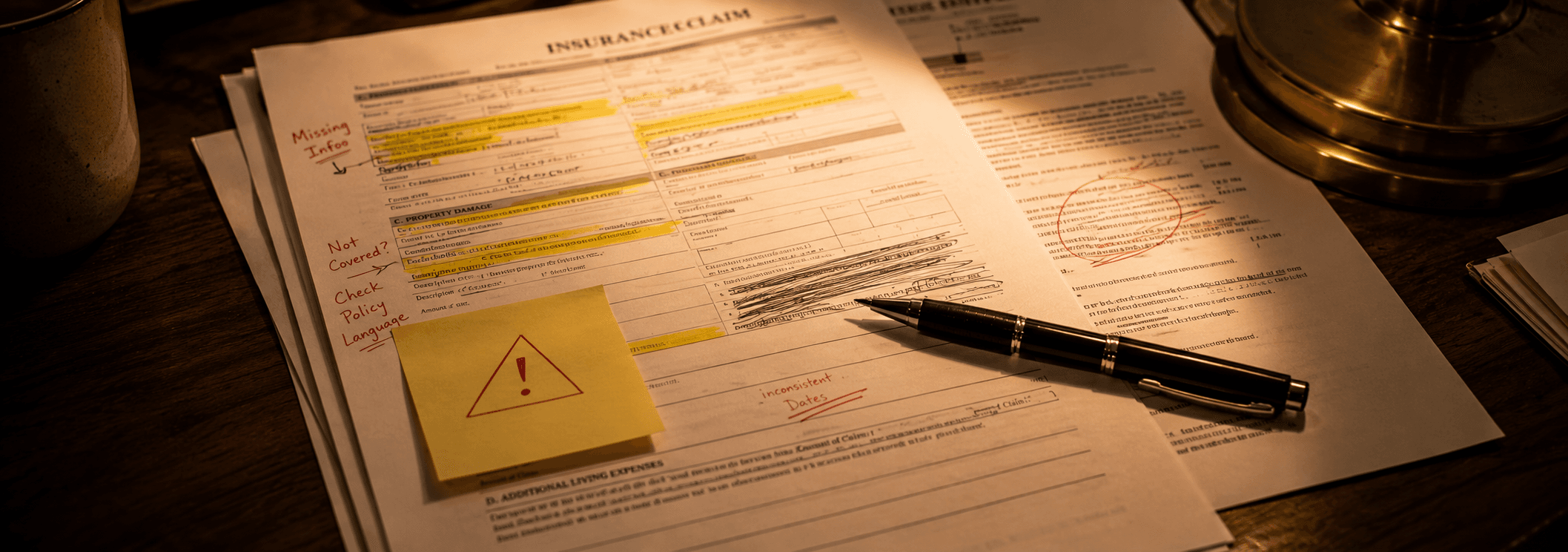
Why Letting a Contractor Deal Directly With Your Insurer Is Risky
After a major loss, the offer to hand off the complexity is attractive. A contractor shows up and says they'll handle everything with your insurance company — you just sign here and focus on your family. The arrangement sounds like a service. In practice, it often isn't.
The mechanism that makes this arrangement possible — an Assignment of Benefits agreement — transfers control of your insurance claim to a third party whose interests are not identical to yours.
What Is an Assignment of Benefits?
An Assignment of Benefits (AOB) agreement is a legal document that transfers your right to collect insurance benefits directly to another party — in this context, your contractor. Once signed, the contractor has the legal standing to negotiate with your insurer, approve scope changes, and collect payment without your involvement.
AOB has legitimate uses in some circumstances. It also has a well-documented history of abuse in disaster-prone markets. Florida and Texas, two states where AOB use in homeowners claims has drawn significant legislative attention, have both enacted restrictions in recent years — Florida through Fla. Stat. §627.7152 (2019 assignment-of-benefits reform, HB 7065). Verified as of 2026-07-20; confirm current law. Rules vary by state and continue to change; check your state's current law.
Why Does This Create Problems for Homeowners?
You lose control of your claim. After signing an AOB, the contractor negotiates with your insurer on your behalf — but without necessarily consulting you on decisions that significantly affect the outcome. Scope changes, settlement offers, and payment structures are decided between the contractor and the insurer. You may find out what was agreed after the fact.
Your interests and the contractor's aren't identical. Your interest is in recovering the full cost of your documented loss. The contractor's interest is in getting paid for the work they do. These overlap significantly — but not completely. A contractor who accepts a lower settlement to close the job quickly hasn't necessarily served your interests.
AOB disputes become your problem. In markets where AOB abuse has been common, insurers fight AOB claims aggressively. Even with a reputable contractor, the AOB arrangement puts you in the middle of a contractual dispute between your contractor and your insurer — which can delay both payment and repairs while you watch from the sidelines.
You may not know what's being negotiated. Without visibility into the contractor-insurer negotiation, you can't evaluate whether the outcome is fair or whether your claim rights are being fully exercised.
What Specific Things Go Wrong?
When a contractor handles your claim through AOB, common problems include:
- Contractors accepting lower scope settlements than the loss actually warrants
- Inflated billing practices that generate insurer disputes — and delays
- Homeowners receiving no payment because the insurer paid the contractor directly under a disputed settlement
- Contractor liens on the property when payment disputes arise
- Homeowners unable to switch contractors because the AOB is with the original firm
What Is the Better Structure?
Maintain control of your own claim:
- You remain the claimant — all insurer communications go to you
- Your contractor provides estimates and documentation that you review and submit
- Payments come to you (and your mortgage servicer if applicable), and you pay the contractor from those funds
- You're informed at every step and able to evaluate whether the outcome is fair
This structure takes more of your time and attention. It also keeps you in control of your insurance claim, which is a right worth protecting.
If a Contractor Presents an AOB Agreement
Don't sign anything at the door. Read it carefully. If it transfers your claim rights, understand what you're giving up before signing. Ask specifically: "Does this agreement transfer my right to collect insurance benefits or negotiate with my insurer?" If yes — take time to research the contractor and consult an insurance professional before signing.
Red flags: pressure to sign immediately, resistance to explanation of what the AOB does, inability to explain what happens if you're unhappy with the outcome.
Frequently Asked Questions
What if the contractor says an AOB is required to start work? AOB is generally not a precondition to a contractor starting work, but confirm before signing anything that transfers your claim rights. You can authorize a contractor to begin mitigation or repair work without transferring your insurance claim rights. If a contractor insists an AOB is mandatory to proceed, that's a signal worth investigating before committing.
Is a public adjuster different from a contractor handling my claim through AOB? Yes — significantly. A licensed public adjuster represents you in the claims process and has a fiduciary duty to act in your interest. They're licensed and regulated by your state insurance department. A contractor handling your claim through AOB has no such duty or regulation.
What if I've already signed an AOB? Review the agreement for cancellation provisions — some states require a right-of-rescission period. Contact an attorney if you have concerns about the arrangement or believe the contractor isn't acting in your interest.
Can I work with a contractor I trust without an AOB? Yes — and this is the recommended approach. Authorize them to provide estimates and perform work. Pay them directly. Maintain control of your claim.
What happens if my contractor and insurer dispute the scope under an AOB? You may find yourself waiting while parties negotiate with each other over a claim that's still in your name. Depending on the jurisdiction and the nature of the dispute, resolution can take months. Your repairs may be halted pending the dispute.
The claims process is already complex. An AOB arrangement adds a layer of complexity that removes your control over the most consequential decisions in it. The homeowners who recover the most from a major loss are almost always the ones who stayed engaged with their claim throughout — understanding what was being settled, evaluating whether it was fair, and directing the outcome. That engagement is what an AOB arrangement prevents.
ClaimEase provides general guidance. Coverage determinations are made by your insurer. Consult a licensed public adjuster or attorney for specific advice about your claim.