How to Track Receipts for ALE and Home Repairs
Learn how to properly track and organize receipts for Additional Living Expenses and home repairs so you get reimbursed faster.
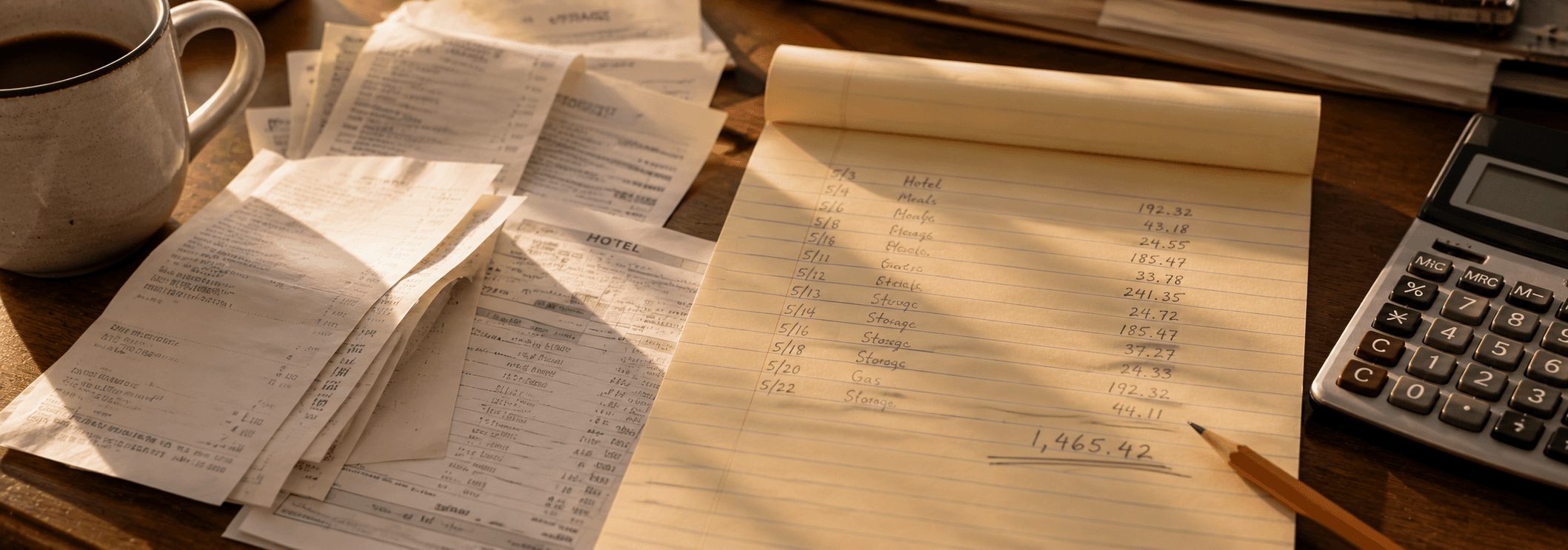
How to Track Receipts for ALE and Home Repairs
When you're displaced after a covered loss, expenses accumulate faster than you expect. Hotels, meals, laundry, storage, emergency repairs, contractor deposits — all of it is potentially reimbursable, and all of it requires documentation. The homeowners who recover the most from ALE and repair reimbursements are almost always the ones who set up a tracking system in the first 24 hours and stuck with it.
The ones who reconstruct expenses from bank statements three months later consistently leave money on the table.
Why Does Receipt Tracking Start on Day One?
Two reasons that directly affect your payout.
First, ALE coverage begins on the date of the covered loss — not the date coverage is confirmed, not the date you get your claim number, not the date the adjuster visits. Every eligible expense from day one is claimable. If you don't track them, you can't claim them.
Second, the insurer needs documentation of actual expenses — not estimates, not general descriptions, not memory. A receipt showing $187.43 at an extended-stay property on a specific date is reimbursable. "I think I spent about $200 on hotels the first week" is not.
What Is the Most Important Separation to Maintain?
Keep ALE expenses strictly separate from repair and mitigation expenses from the first day. This is the most consequential tracking decision you'll make.
ALE (hotel, meals, storage, laundry) falls under Coverage D — Additional Living Expense — with its own limit, typically 20-30% of your Coverage A limit. Emergency mitigation (water extraction, tarps, board-up) and repair costs fall under Coverage A — Dwelling — with a completely different limit.
Mixing them creates two problems: the insurer has to untangle the categories before processing, which delays payment; and expenses applied against the wrong limit can exhaust one coverage category while another has room remaining.
Use two separate folders, two separate expense sheets, two separate submission packets — whatever system you use, the separation must be absolute.
What Is the Most Practical Phone-Based Tracking System?
Most people will not maintain a spreadsheet during a crisis. The system needs to require almost no friction to work.
The simplest approach that actually works:
-
Photograph every receipt immediately — before you put it in your pocket, before you leave the restaurant, before the paper gets lost. Your phone's camera roll becomes your primary receipt archive.
-
Name the photo immediately — or use a notes app to log the expense with four pieces of information: date, amount, vendor, category (ALE or repair). Thirty seconds after the photo, while it's still in front of you.
-
Two cloud folders — one labeled "ALE" and one labeled "Repairs/Mitigation." Move each receipt photo to the correct folder the day you capture it. Cloud storage (Google Drive, iCloud, Dropbox) means you don't lose everything if your phone is damaged or lost.
-
Weekly reconciliation — once a week, spend 20 minutes reviewing the week's receipts against your expense log, confirming nothing is missing, and adding any expenses you paid digitally without a physical receipt.
ClaimEase's expense tracking links receipts to specific claims and categories, replacing the folder system with a structured log that's already organized for submission.
What Do You Do When You Don't Have a Receipt?
Digital payment records — credit card statements, bank statements, PayPal or Venmo records — show the date, amount, and vendor and substitute for paper receipts in most cases. Download and save them in your expense folders alongside photos.
Email confirmations — hotel booking confirmations, rental agreements, contractor confirmation emails — are receipts. Forward them to a dedicated claim email folder immediately.
Monthly statements — for recurring ALE expenses like a monthly storage unit or extended-stay rental, the monthly invoice plus a bank statement showing payment is typically sufficient documentation.
Note missing receipts immediately — if you know you incurred an expense and don't have the receipt, log it with as much detail as you can (date, approximate amount, vendor, purpose) and flag it as needing documentation. It's easier to recover a receipt within a week than to reconstruct it months later.
What Are the Most Common Tracking Failures?
Not tracking from day one. The first few days after a loss are the most chaotic — and the expenses are often the largest. These are exactly the expenses that don't get tracked.
Mixing categories. ALE and repair expenses in the same folder, the same submission, or the same spreadsheet create processing problems and potential limit confusion.
Losing paper receipts. Photograph every paper receipt immediately — they fade, get damaged, and disappear from pockets. The photo is the receipt that matters.
Not documenting the baseline. For meal and housing ALE claims, the insurer needs to know your normal baseline expenses to calculate the increase. Pull 3-6 months of pre-loss bank statements early and keep them with your claim documentation.
Waiting until submission to organize. Organizing 90 days of receipts in preparation for a submission takes hours and produces an inferior result compared to a system that stays current throughout.
Frequently Asked Questions
How long do I need to keep receipts after the claim is settled? At minimum three to five years after settlement. Some claim issues — disputed depreciation recovery, supplemental damage that surfaces after closure, or bad faith claims — can arise after initial settlement. A complete expense record is your protection.
What if my insurer asks for original receipts? Most insurers accept clear photos or scans of original receipts. If originals are specifically required, submit copies and retain the originals. Never send originals without keeping copies.
Can I claim reimbursement for expenses I forgot to track? Partially. Bank and credit card records can reconstruct many expenses — they show vendor, date, and amount, which is often sufficient. Expenses paid in cash without any record are harder to recover. This is why day-one tracking prevents losses that can't be recovered later.
What expense tracking apps work well for insurance claims? Any app that captures photos, adds date and amount metadata, and allows folder organization works. Google Drive, Dropbox, and Apple Files are simple and reliable. Dedicated receipt apps like Expensify or Receipts by Wave work well for claims with high expense volume. The best app is the one you'll actually use consistently.
Should I submit receipts as I go or wait until the claim is settled? Submit in organized monthly batches rather than waiting until settlement. Waiting creates a large, complex submission that takes longer to process and is harder to track. Monthly batches give you regular reimbursements and flag any categorization issues early, while the details are still fresh.
Receipt Tracking Checklist
- Start tracking on the date of loss — ALE coverage begins that day
- Maintain two strictly separate categories from day one: ALE and repairs/mitigation
- Photograph every paper receipt immediately — before it leaves your hand
- Two cloud folders: "ALE" and "Repairs" — move photos same day
- Log digital payments (credit card, bank transfer) with date, amount, vendor, and category
- Pull 3-6 months of pre-loss bank statements to establish your normal expense baseline
- Reconcile weekly — don't let receipts pile up
- Submit in organized monthly batches, not at settlement
ClaimEase provides general guidance. Coverage determinations are made by your insurer. Consult a licensed public adjuster or attorney for specific advice about your claim.