The First 24 Hours After Home Damage: What to Do Immediately
Emergency steps for safety, mitigation, and documenting damage immediately after a loss.
The First 24 Hours After Home Damage: What to Do Immediately
The first 24 hours after home damage are the most consequential of the entire claim. Decisions made — and things left undone — in this window affect your safety, your coverage, and what you ultimately get paid. Most of the costly mistakes in insurance claims happen here, in the chaos before things settle down.
Work through this in order. Every step matters.
Step 1: Is Everyone Safe?
Before anything else — before photos, before calling your insurer, before anything — confirm that everyone is out of danger.
- Evacuate immediately if there's structural compromise, fire, gas smell, active flooding, or any immediate hazard
- Call 911 for any emergency requiring fire, medical, or police response
- Don't re-enter until emergency services confirm it's safe to do so
- Shut off utilities only if you can do so safely — gas at the meter, water at the main valve, electricity at the breaker panel
The claim can wait. Do not go back into an unsafe building to retrieve belongings or take photos.
Step 2: How Do You Stop the Damage From Getting Worse?
Most policies include a "duty to mitigate" — your obligation to take reasonable steps to prevent additional damage after a covered loss. Failure to mitigate gives insurers grounds to dispute the portion of damage that occurred after the initial event.
Water damage: Shut off the water source at the main valve. Move valuables out of the path of spread. Place towels or containers to limit migration while professional extraction is arranged.
Roof damage: Tarp exposed areas if it's safe to do so. Don't go on a wet or structurally compromised roof — call an emergency roofing contractor.
Fire damage: Once the fire is out, secure openings from weather and unauthorized entry.
Storm damage: Board up broken windows and doors to prevent water intrusion.
Save every receipt from emergency mitigation work. Tarps, board-up services, water extraction, emergency plumbing — these costs are generally reimbursable under your dwelling coverage and require documentation to claim.
Step 3: Why Must You Document Before Cleanup?
Here's where most homeowners make the most expensive mistake of the entire claim: they start cleaning up before they document.
Don't. Not yet.
Walk through every affected area with your phone camera first. Take wide establishing shots from the doorway of each room, mid-range shots of damage zones, and close-up detail shots of specific damage. Then record a narrated video walkthrough — say the date and time aloud at the start, walk slowly, describe what you're seeing.
- Photograph damaged personal property in place before anything is moved or discarded
- Capture serial numbers on damaged appliances and electronics
- Document all four exterior faces — roof, siding, fencing, vehicles if affected
- Don't discard anything yet — damaged items are evidence, and disposing of them without authorization can exclude them from your contents claim
Then mitigate. Then clean up.
Step 4: When and How Do You File the Claim?
Most policies require prompt notice — file within 24-48 hours of the loss where possible. Late reporting gives insurers grounds to challenge the claim even when damage is clearly covered.
Have ready before you call:
- Your policy number
- Date, time, and cause of loss — be specific: "a pipe burst behind the bathroom wall" not "water damage"
- A general description of affected areas
- Your contact information
Before you hang up, confirm and write down:
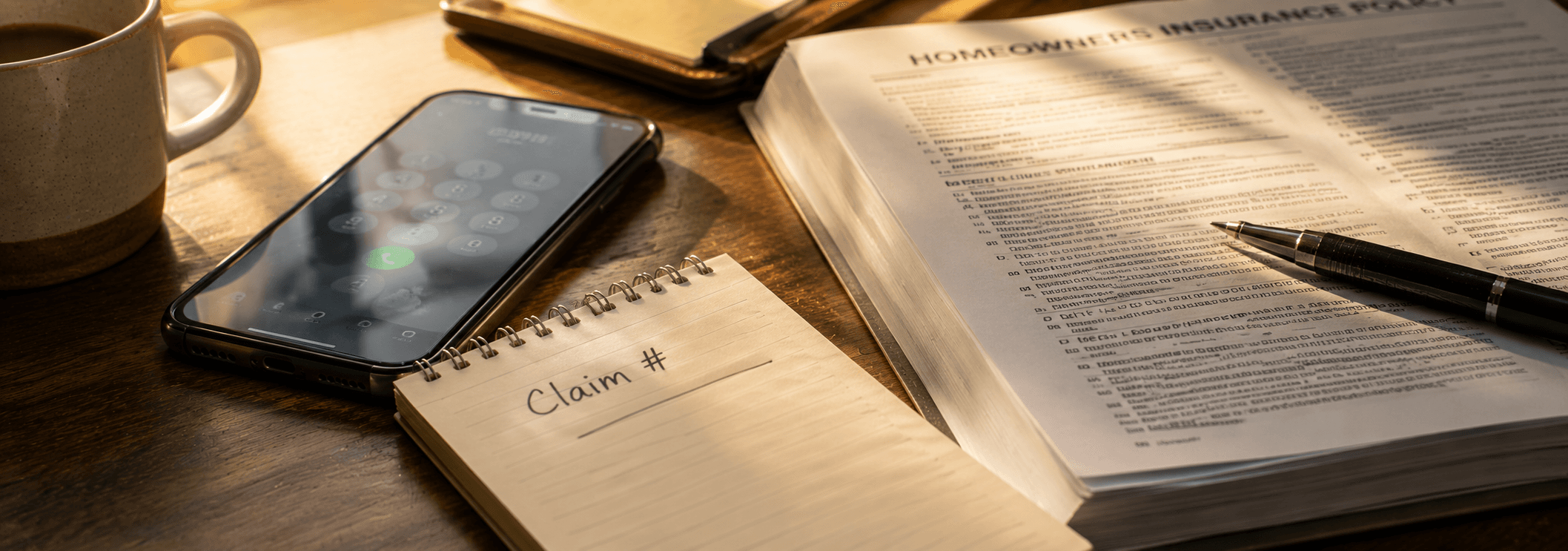
- Your claim number
- When an adjuster will be assigned
- What your ALE limit is if your home is uninhabitable
- Whether emergency mitigation expenses are reimbursable and the submission process
That ALE question matters immediately if you're displaced. Your coverage limit determines what you can spend on housing tonight — not after you've run up a hotel bill you weren't sure would be covered.
Step 5: What Records Do You Need to Start Immediately?
From the moment you hang up with your insurer, every claim-related conversation goes in writing. Date, who you spoke with, what was discussed, what was promised, and by when.
This log is one of your most valuable assets if the claim gets complicated over the months ahead. Memory fades. Written records don't.
Step 6: What Do You Do If Your Home Is Uninhabitable?
Your policy's Additional Living Expense coverage — Coverage D — is active now. ALE typically covers the increase above your normal living costs: hotel stays above what you'd normally pay for housing, meals above your typical food budget, laundry, storage, pet boarding.
ALE covers the increase, not your total displacement costs. If your mortgage is $1,800/month and a hotel runs $3,200/month, your ALE claim is roughly $1,400/month — not $3,200. Track accordingly, with receipts for everything.
Start tracking from tonight. ALE limits — typically 20-30% of your Coverage A limit — run from the date of loss, whether or not you're submitting receipts yet.
Step 7: Do You Need to Notify Your Mortgage Servicer?
Yes, for any significant structural loss. Your mortgage lender is almost certainly listed as a loss payee on your policy. For structural damage claims, insurance checks are typically issued jointly to you and your lender — meaning you can't cash or deposit them without the lender's endorsement.
Contact your servicer to notify them of the loss and ask about their endorsement process. This takes 10 minutes now and prevents a significant delay when checks start arriving.
Frequently Asked Questions
What if I can't find my insurance policy in the first 24 hours? Call your insurer's main line — they can locate your account by name, property address, and date of birth. Don't delay filing because you can't locate policy documents. The policy number is also typically accessible through your insurer's mobile app or online portal.
Can I stay in a hotel right away even before the adjuster approves it? Yes. If your home is unsafe or uninhabitable, you don't need adjuster approval to arrange housing. Keep all receipts and document that the home was uninhabitable — photos and a written note from emergency services or a contractor confirming the condition. ALE reimbursement is triggered by the uninhabitable condition, not by adjuster approval.
What counts as emergency mitigation versus permanent repair? Emergency mitigation stops the loss from getting worse — tarps, board-up, water extraction, temporary fencing. These are generally expected and reimbursable. Permanent repairs restore the property — new drywall, flooring, roofing. These require the adjuster's inspection first. The line is: did this action stop further damage, or did it begin restoration? When in doubt, ask your insurer in writing before proceeding.
Should I contact a contractor in the first 24 hours? For emergency mitigation, yes — contact a licensed restoration contractor immediately if you have water damage, a compromised roof, or other conditions requiring urgent professional response. For general repairs and estimates, start scheduling within 48 hours. Getting independent contractor estimates before the adjuster visit strengthens your position considerably.
What if the damage happened while I was out of town? File the claim immediately upon discovering the damage. Be accurate about when you first became aware of it — not speculation about when it might have occurred. The documentation process is the same; start it as soon as you can safely access the property.
First 24 Hours Checklist
- Safety first — evacuate, call 911 if needed, shut off utilities only if safe
- Mitigate immediately: shut off water, tarp, board up — save every receipt
- Document everything before cleanup: photos, detail shots, video walkthrough
- Don't discard anything without documentation and authorization
- File the claim within 24-48 hours — get your claim number and ALE limit on the first call
- Start your claim log immediately after hanging up
- Track all ALE expenses from tonight — hotel, meals above normal, storage — with receipts
- Notify your mortgage servicer for any significant structural loss
ClaimEase provides general guidance. Coverage determinations are made by your insurer. Consult a licensed public adjuster or attorney for specific advice about your claim.