The Homeowner's Fire Claim Playbook
What insurance doesn't explain — and what experienced claim handlers know. An 8-part guide covering the first 72 hours through final settlement, with dedicated sections on the contents inventory methodology, smoke and soot coverage rules, SIU investigations, and the ALE documentation discipline for a 12–18 month rebuild.
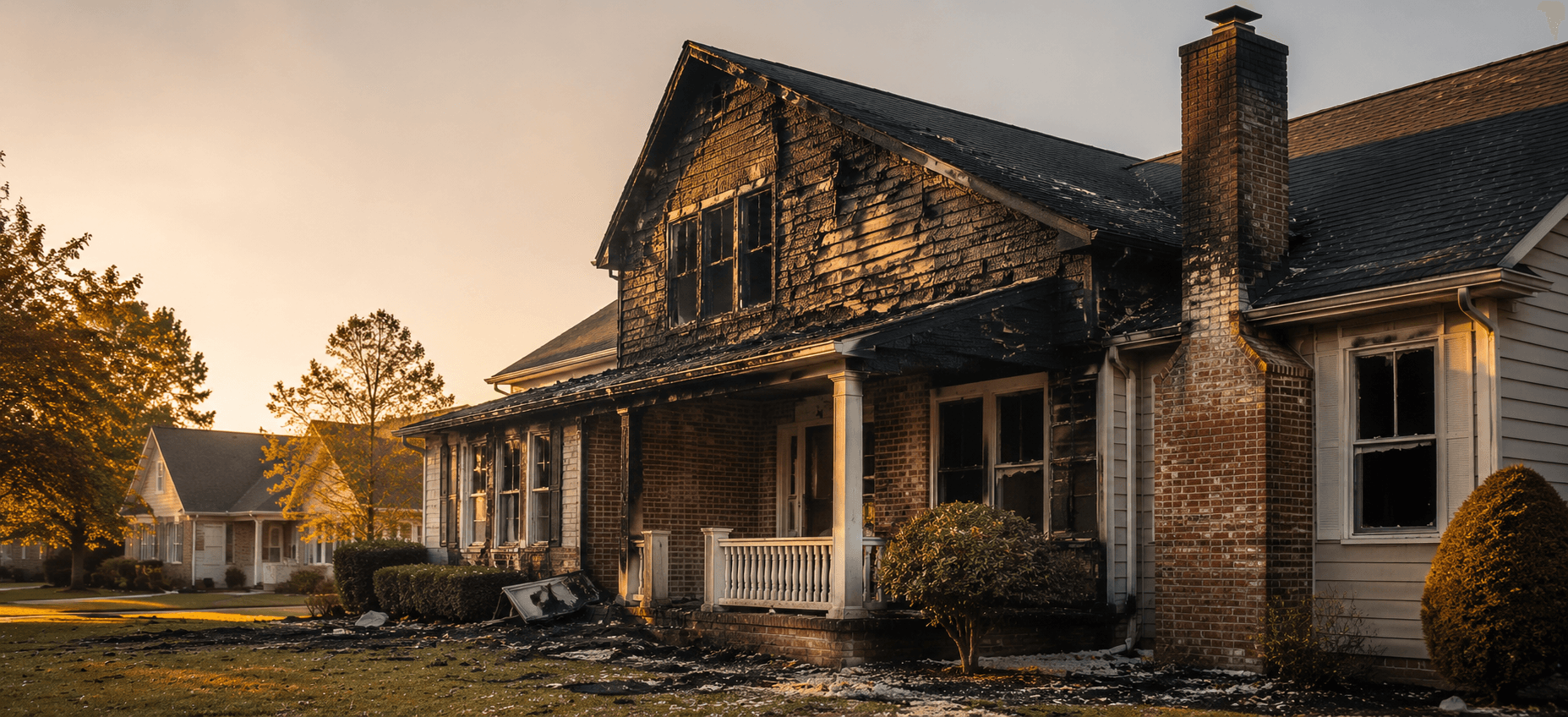
The Homeowner's Fire Claim Playbook
A fire claim is the most paperwork-heavy, longest-running claim a homeowner is likely to face. The carrier has a process. You need one too — from the first 72 hours through final settlement 12 to 24 months later.
This guide covers what most homeowners don't learn until they're already in the middle of it: the documents you should never sign in the first week, what smoke damage actually does to a home, how the investigation process works, and what it takes to recover every dollar your policy promises.
The First 72 Hours
Safety and access. Don't re-enter until the fire department clears the structure. Even after the fire is out, structures can be unstable, electrical systems can be live, and air quality inside can be hazardous for days. Respect red and yellow tags — they exist because the building is genuinely dangerous.
Notify your carrier within 24 hours. You're reporting the loss — not giving a recorded statement, not agreeing to a scope, not committing to anything. Get a claim number, get the adjuster's name and contact information, and ask what they need in the first week. If your carrier asks for a recorded statement on the first call, decline politely and say you'll provide one after assessing the situation.
Set up ALE immediately. If your home is uninhabitable — and after most fires it is, even when the structure is largely intact because of smoke and soot — ALE starts the day you're displaced. Get into temporary housing tonight. Save every receipt. Call your carrier and ask for an ALE advance; most will issue an initial check within a few days if you ask.
Document before you touch anything. Photos and video of the exterior from every angle, then interior room by room before anything is moved or removed. Every surface, every room, every damaged item in place. Once cleanup begins, the physical evidence changes. Get this done first.
What Not to Sign in the First 72 Hours
Within hours of a fire — sometimes while the trucks are still on scene — you will be approached by restoration contractors, public adjusters, attorneys, and content pack-out companies. Some are legitimate. The problem is you cannot tell which is which while exhausted and standing in front of what used to be your house.
Do not sign an Assignment of Benefits. An AOB transfers your insurance claim rights to the contractor. Once signed, the contractor controls the claim, negotiates with your carrier directly, and can place a lien on your property if the carrier underpays them. AOBs are the single most common way fire claims go catastrophically wrong. Do not sign one at any point without independent legal review.
Do not sign a contingency contract with a public adjuster on day one. PAs can be valuable — sometimes essential — but make that decision after seeing how your carrier handles the claim, not before they've even assigned an adjuster.
Do not sign any carrier preferred-vendor contract without reading it. Carrier-preferred vendors work for the carrier, not for you.
Do not throw anything away. Not the burned debris, not smoke-damaged contents, not the food in the refrigerator. Everything is evidence and potential claim value until the carrier has documented it.
If someone is pressuring you to sign something in the first 48 hours, that pressure itself is a red flag. Legitimate professionals give you time to make decisions.
What's Actually Covered
Your homeowners policy organizes fire coverage into four buckets — each with its own limit:
Coverage A (Dwelling): The structure. Walls, roof, foundation, attached garage, built-in fixtures, plumbing, electrical, HVAC. Your Coverage A limit is the maximum for repair or rebuild.
Coverage B (Other Structures): Detached garage, shed, fence, pool house. Usually 10% of Coverage A by default.
Coverage C (Personal Property): Everything inside the home. Furniture, clothing, electronics, appliances, kitchen items, tools, books. Usually 50-70% of Coverage A. Most policies pay ACV upfront and withhold depreciation ("recoverable depreciation") until you replace the item and submit proof. The deadline to recover withheld depreciation is commonly 180 days to one year — calendar it from day one.
Coverage D (ALE): Additional living expenses while uninhabitable. Usually 20-30% of Coverage A, sometimes with a time limit of 12 or 24 months. Check both the dollar limit and the time limit on your declarations page.
Critical endorsements on fire claims:
- Ordinance & Law: Covers code-required upgrades during rebuild. Default limits of 10% of Coverage A are almost always inadequate on older homes.
- Debris Removal: Often a sublimit within Coverage A — commonly 5%. On a total loss, debris removal can run $20,000-$50,000, especially with hazardous materials.
- Scheduled Personal Property: Separate endorsement for high-value items. Without it, jewelry is capped at $1,500-$2,500 total, firearms at $2,500, art at typically $2,500 per item — regardless of actual value.
Know your numbers from the declarations page before the adjuster arrives.
Smoke, Soot, and Hidden Damage
Even when a fire is contained to one part of the house, the damage rarely is. This is where fire claims most consistently underpay — and where your documentation makes the biggest difference.
How smoke and soot move through a home: HVAC systems pull smoke and soot into ducts and distribute particulates to every room. Smoke rises through stairwells to upper floors and attics. Soot deposits on every surface it touches. Acidic soot residue continues to damage materials for weeks if not properly cleaned.
What carriers commonly try to minimize:
HVAC systems. The carrier may scope duct cleaning when full replacement is warranted. The standard is whether cleaning can fully remove soot residue. With older flex duct or insulated duct, it often can't. An HVAC contractor experienced in fire restoration should make this call.
Electronics. Soot is conductive and corrosive. Devices that work today may fail in months as soot oxidizes internal components. The standard is inspection by a qualified electronics restoration specialist — not whether the device currently powers on.
Soft goods. Upholstered furniture, mattresses, rugs, curtains, and clothing absorb smoke odor at a molecular level. Professional cleaning succeeds sometimes; fails others. Items that fail professional cleaning are a covered loss.
Drywall and insulation. Smoke odor penetrates drywall. Sealing and repainting is sometimes sufficient for visible surfaces. Insulation exposed to smoke typically cannot be cleaned and warrants replacement.
Cabinets and food. Surface cleaning may remove visible soot but not deep odor. Anything in open containers, porous packaging, or exposed to heat is a covered loss — including refrigerator and freezer contents if power was lost.
For a significant fire claim, engage specialists: an industrial hygienist to test indoor air quality and combustion byproducts, an electronics restoration specialist for every powered device, a textile specialist for high-value soft goods. Testing costs are typically covered by the policy.
The Investigation Phase
Almost every significant fire claim involves a cause and origin investigation. For most homeowners this is routine. Understanding when it becomes adversarial — and what to do if it does — protects you from one of the most disorienting experiences in insurance claims.
Routine investigation: A contracted fire investigator examines the burn patterns, interviews you, and produces a report identifying the probable cause. Common findings — kitchen fire, electrical, space heater, lightning — close out cleanly in a few weeks. Cooperate fully. Walk the investigator through what happened. Most investigations end here.
SIU involvement: Sometimes investigation triggers the carrier's Special Investigations Unit — their anti-fraud unit. Triggers include recent policy changes, financial stress, prior claims, inconsistencies in your account, or a cause the investigator cannot rule out as intentional. SIU involvement does not mean you've done anything wrong — many SIU investigations close without action. But the process can take months and effectively freezes the claim.
Cooperation duties, and how a recorded statement or EUO can be used, are set by your policy and by state law and vary — the description below is general. Before any EUO, and before any statement requested by SIU rather than the assigned adjuster, consult a licensed public adjuster or attorney.
Recorded statements: The carrier will likely ask for a recorded statement. Most policies require cooperation. That is not the same as giving a statement on demand or without preparation — it is reasonable to schedule it once you have your timeline documented. Before giving one: know your timeline cold, have it written down to avoid inconsistencies, and understand that "I don't remember" is a valid answer. If the request comes from SIU rather than the regular adjuster, consider having representation present.
Examination Under Oath (EUO): A more formal proceeding — sworn testimony transcribed by a court reporter with the carrier's attorney asking questions. EUOs arise when the carrier is seriously considering denial. If asked to sit for one, consult a public adjuster or attorney first. An EUO is not a casual conversation. Inconsistent sworn testimony can be used to support a claim denial.
When people commonly seek representation: SIU has been assigned; an Examination Under Oath has been requested; the investigation has run past 90 days; coverage has been denied on any portion of the claim; or the documentation the claim requires has grown beyond what you can reasonably assemble on your own.
The Contents Inventory
A fire contents inventory on a total loss can run to a thousand items and is done largely from memory. This is a multi-week project — pace it accordingly.
Room-by-room reconstruction: Start with a floor plan. For each room, sit somewhere quiet and walk through it in memory from one corner, moving clockwise. List every item. Don't filter for what you think is "worth claiming" — pillows, picture frames, medicine cabinet contents, food in the pantry. Everything. Do this with every adult in the household separately, then compare lists.
Evidence sources: Every photo taken inside your home over the years — birthday parties, holidays, family gatherings — shows contents in the background. Pull from your phone, your partner's phone, iCloud, Google Photos, Facebook, Instagram. Online order histories (Amazon, Wayfair, Best Buy, Costco, Apple) go back years with exact prices. Credit card and bank statements identify major purchases at furniture stores, appliance retailers, electronics stores. Real estate listing photos from when you bought the home. Email receipts. Family members who visited regularly.
Building line items: For each item: specific description with brand and model, age, current replacement cost (what it costs to buy an equivalent today — not what you paid), quantity, and your evidence source. Research current retail pricing carefully — a ten-year-old television may be replaced by a current equivalent at a lower price; a solid wood table purchased for $800 fifteen years ago may now cost $2,200 to replace.
High-value items and sub-limits: Without a scheduled endorsement, jewelry coverage is capped at $1,500-$2,500 combined, firearms at $2,500, art typically at $2,500 per item. These are the most common and most painful surprises in fire claims. There's nothing to do about them after the fact — but understanding them shapes realistic expectations for the settlement.
ALE: Living Through the Rebuild
ALE on a fire claim typically runs 12-18 months. Done right, it keeps your family stable. Done poorly, it creates a second source of financial stress.
What ALE covers: The increase in your living expenses above your normal baseline. Lodging in temporary housing. Increased food costs when you're eating out because you don't have a kitchen. Pet boarding when your temporary housing doesn't accommodate pets. Additional mileage if you're driving farther to work or school. Laundry. Storage. The increase — not all of your expenses.
The comparable-housing standard: Most ALE provisions are written to cover temporary housing comparable to your pre-loss home rather than a reduction in living conditions — the exact standard is set by your policy's language. A household that had a four-bedroom house in a particular school district is generally looking at comparable housing, not a studio. Read the ALE provision in your policy and confirm how the standard applies with your adjuster in writing. If offered housing below your pre-loss standard, you can document and dispute it.
Documentation discipline: One folder per month, every receipt. A simple spreadsheet tracking lodging, food, mileage, pet, laundry, storage. Notes on food receipts explaining the displacement context. Submit monthly — reimbursement only starts when you submit. Track cumulative spending against both the dollar limit and the time limit on your dec page. Don't be surprised by either cap.
The mortgage complication: Dwelling checks are typically issued jointly to you and your mortgage servicer. The servicer releases funds in draws as rebuild milestones are verified by inspection. Get the servicer's loss draft department contact information early. ALE checks typically come directly to you without this complication.
The Rebuild
Ordinance and Law costs are always higher than homeowners expect. A fire rebuild must meet current building codes. Common code-driven costs that didn't exist in the original construction: fire sprinkler systems, hardwired interconnected smoke detectors, egress windows, updated electrical service, energy efficiency requirements, foundation and structural standards, accessibility requirements. In wildfire-risk areas: ember-resistant vents, ignition-resistant siding, defensible space. These costs are covered only up to your O&L limit. At 10% of Coverage A, the math often doesn't work on an older home.
Realistic rebuild timeline for a total loss: 1-3 months for scope settlement and contractor selection; 2-4 months for permitting (longer after major regional fire events when every homeowner is permitting simultaneously); 6-12 months for construction; 1-2 months for punch list and certificate of occupancy. Total: 10-21 months. Optimistic timelines from contractors and carriers are usually wrong.
Choosing a builder: Verify license and bonding in your state, general liability and workers' comp, and references specifically from prior fire insurance rebuilds. Get at least three bids. The gap between the carrier's scope and your contractor's bid is the negotiation. Look for no AOB language in the contract, a draw schedule tied to documented milestone completion, and lien waivers at each draw.
Depreciation recovery at closeout: For each contents item you replace, submit the receipt to recover the withheld depreciation. This is tedious work on a major fire claim. It also represents tens of thousands of dollars. The deadline is commonly 180 days to one year from the date of loss — calendar it and don't let ALE/rebuild fatigue cause you to miss it.
State-Specific Notes
California. Wildfire-adjacent building code requirements — California Building Code, Chapter 7A (Materials and Construction Methods for Exterior Wildfire Exposure) — apply to fire rebuilds in high-risk areas, creating substantial O&L exposure. Verified as of 2026-07-20; confirm current law. California has also enacted post-disaster protections, including non-renewal limits that apply after a declared emergency — these provisions have been amended repeatedly. Verify current law and confirm applicability with the California Department of Insurance at insurance.ca.gov.
Texas. Prompt payment is set by Tex. Ins. Code §§542.055–.058 (Prompt Payment of Claims Act) — acknowledge within 15 days (§542.055), accept/reject within 15 business days of receiving the items required for proof of loss (§542.056), pay within 5 business days of acceptance (§542.057). Verified as of 2026-07-20; confirm current law. Complaints at tdi.texas.gov.
Florida. AOB restrictions enacted in recent years limit contractor claim assignments — know your rights before signing anything. Florida Department of Financial Services at myfloridacfo.com.
All states. Acknowledgment and decision timelines are set by state regulation and vary — look up your state's claim-handling rule rather than relying on a general range. State insurance departments handle regulatory complaints — a regulatory complaint creates a record the insurer must respond to within a defined timeframe.
Frequently Asked Questions
My carrier assigned SIU to my claim. What does that mean? SIU is the carrier's Special Investigations Unit — their anti-fraud team. Assignment doesn't mean you've done anything wrong; many SIU investigations close without action. It does mean the claim is on a slower, more formal track. Your duty to cooperate during an investigation — and what a recorded statement or an Examination Under Oath involves — is set by your policy language and by your state's insurance law, and both vary; many policyholders consult a licensed public adjuster or attorney before providing either. Document every communication with timestamps and treat all adjuster interactions as formal.
The adjuster scoped duct cleaning but my restoration contractor says the ducts need full replacement. Who's right? The adjuster made an initial determination. It can be changed with documentation. Get a written assessment from an HVAC contractor with fire restoration experience specifically stating why the ducts cannot be adequately cleaned and why replacement is warranted. Submit it as a supplement request.
How much time do I have to submit my contents inventory? Most policies have a 60-day Proof of Loss requirement — but for contents specifically, the practical practice is to submit as you compile. Discuss the timeline with your adjuster explicitly on the first call. Ask for confirmation in writing of the deadline. If you need more time than the standard deadline, request an extension in writing before the deadline passes — most carriers grant them.
I had a $15,000 engagement ring that wasn't on a scheduled rider. What do I recover? Only the jewelry sub-limit — typically $1,500-$2,500 regardless of the actual value and regardless of your overall Coverage C limit. This is one of the harshest consequences of the sub-limit structure. There's nothing to do about it after the loss. Going forward: any item of significant value should have a scheduled endorsement with a current appraisal.
What is a public adjuster, and when does the question usually come up on a fire claim? Plenty of homeowners work a fire claim through to closeout themselves; others bring in licensed help, and on fire claims the question tends to surface around the contents inventory, where a total loss means reconstructing a whole household — often a thousand line items — from memory and old photographs. A public adjuster is a claims professional licensed and regulated by the state, working for the policyholder rather than for the carrier. Fees are customarily a percentage of the claim payment, commonly cited in the range of 10 to 15 percent, and are capped by statute in some states. A license and any disciplinary history can be verified with your state insurance department, and the fee basis should be read in full before anything is signed.
What's the biggest mistake homeowners make in fire claims? Signing an Assignment of Benefits in the first 48 hours under pressure from a contractor. It transfers claim control to a third party whose interests are not identical to yours, and unwinding it is difficult. The second biggest mistake is accepting the initial contents settlement without filing for recoverable depreciation. On a replacement cost policy, the withheld depreciation is issued as a second payment after items are replaced and receipts are submitted — and it has to be filed for before the policy's deadline, commonly 180 days to one year from the date of loss.
A fire claim handled well requires documentation discipline from the first hour, understanding your coverage before the adjuster arrives, and knowing what the investigation process looks like before it happens to you. The work is real — a thousand-item contents inventory, 18 months of ALE expense reports, supplement negotiations, and depreciation recovery deadlines. So is the money at stake.
ClaimEase organizes every workstream in one place — from day one through final settlement — so the documentation discipline doesn't break down under the weight of a claim that lasts two years.
ClaimEase provides general guidance. Coverage determinations are made by your insurer based on your specific policy terms. Consult a licensed public adjuster or insurance attorney for specific advice about your claim. State laws and policy terms vary.